|
|
| Rock City and Chattanooga Area |
|
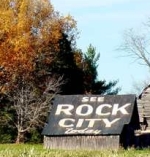
Rock City is a roadside attraction near Chattanooga, Tennessee on Lookout Mountain in Lookout Mountain, Georgia, located near Ruby Falls. It is well-known for the many barn roofs throughout the southeast United States that have the slogan "See Rock City" painted on their roofs. In total, over 900 barn roofs in nineteen states were painted by Clark Byers for Rock City. The publicity and lore claim that it is possible to see seven states from Lover's Leap, a point in Rock City. roofs throughout the southeast United States that have the slogan "See Rock City" painted on their roofs. In total, over 900 barn roofs in nineteen states were painted by Clark Byers for Rock City. The publicity and lore claim that it is possible to see seven states from Lover's Leap, a point in Rock City.
Ruby Falls is an 145-foot high underground waterfall located within Lookout Mountain, near Rock City. In the 1920s a chemist and cave enthusiast named Leo Lambert thought that he could re-open the cave as a tourist attraction, and formed a company to do so. He planned to make an opening further up the mountain than the original opening and transport tourists to the cave via an elevator. For this purpose, his company purchased land on the side of Lookout Mountain above Lookout Mountain Cave and in 1928 began to drill through the limestone. In doing so, they discovered a small passageway about 18 inches high and four feet wide. Exploring this opening, Lambert discovered the formerly hidden Ruby Falls Cave and its waterfall. On his next trip to visit the cave, Lambert took his wife Ruby, and told her that he would name the falls after her.
|
 |
| |
|
| Chickamauga Battlefield (Georgia) |
|
| The Battle of Chickamauga, fought September 18 to September 20, 1863, marked the end of a Union offensive in south-central Tennessee and northwestern Georgia called the Chickamauga Campaign. The battle was the most significant Union defeat in the Western Theater of the American Civil War. The battle was fought between the Union Army of the Cumberland under Maj. Gen. William Rosecrans and the Confederate Army of Tennessee under General Braxton Bragg, and was named for the Chickamauga Creek, which flows into the Tennessee River about 3.5 miles (5.6km) northeast of downtown Chattanooga. Chickamauga was a local Indian word meaning "Stagnant River" or, less accurately, "River of Death," a usage that may have begun after the battle. Considered a Confederate victory for halting the Union advance, the Battle of Chickamauga was a costly one. It claimed an estimated 34,624 casualties (16,170 for the Union; 18,454 for the Confederates).
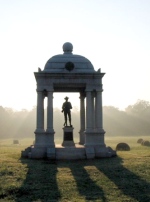
In the 1890s, the Congress of the United States authorized the establishment of the first four national military parks: Chickamauga and Chattanooga, Shiloh, Gettysburg, and Vicksburg. The first and largest of these, and the one upon which the establishment and development of most other national military and historical parks was based, was at Chickamauga, GA. It owes its existence largely to the efforts of Generals Henry V. Boynton and Ferdinand Van Derveer, both veterans of the Union Army of the Cumberland, who saw the need for a federal park to preserve and commemorate these battlefields during a visit to the area in 1888. The 5,200 acre Chickamauga Battlefield contains numerous monuments, historical tablets, wayside exhibits, and trails.
|
 |
| |
|
|
|
 |
|


