|
Introduction
Over the past year, The Blount Academy of Excellence (Enrollment: 2) has been studying early American history. We have spent a good bit of time studying the American Revolution and we decided to embark on a field trip to some of the rich, historical sites of the northeast USA so that the kids could experience some of what they have been learning. We split our trip into two parts. The first part of the trip occured in July to Jamestown, Williamsburg, and Philadelphia; and was sans Mark. The second portion of the trip to New York City and Washington DC was the first two weeks of September and we enjoyed it as a family. The sections below include our travel journal and pictures of the adventures we had at each of these destinations.
|
Philadelphia, Pennsylvania
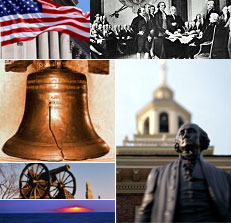
Philadelphia was the stage for many history-making events, the home of several prominent citizens and statesmen, and the site of some famous landmarks. The original capital of the nation, Philadelphia was laid out by William Penn Jr in 1682, on a grid  system that was to provide the pattern for most American cities. It was envisaged as a "greene countrie towne", and today, for all its historical and cultural significance, it still manages to retain a certain quaintness. Just a few blocks away from the noise, crowds, heat and dust of downtown, shady cobbled alleys stand lined with red-brick colonial houses, while the peace and quiet of huge Fairmount Park make it easy to forget you're in a major metropolis. Economic power fueled strong revolutionary feeling, and the city was the capital during the War of Independence (except for nine months under British occupation in 1777-78). It also served as the US capital until 1800, while Washington DC was being built. The Declaration of Independence was written, signed and first publicly read here in 1776, as was the US Constitution ten years later. Philadelphia was also a hotbed of new ideas in the arts and sciences, as epitomized by the scientist, philosopher, statesman, inventor and printer Benjamin Franklin. Over the years, Philadelphia has had many nicknames, such as "Quaker City", "City of Brotherly Love", "Cradle of the Revolution", and "Nation's Birthplace".
In 1800, Philadelphia was the country's largest city. CLICK HERE TO BEGIN THE ADVENTURE » system that was to provide the pattern for most American cities. It was envisaged as a "greene countrie towne", and today, for all its historical and cultural significance, it still manages to retain a certain quaintness. Just a few blocks away from the noise, crowds, heat and dust of downtown, shady cobbled alleys stand lined with red-brick colonial houses, while the peace and quiet of huge Fairmount Park make it easy to forget you're in a major metropolis. Economic power fueled strong revolutionary feeling, and the city was the capital during the War of Independence (except for nine months under British occupation in 1777-78). It also served as the US capital until 1800, while Washington DC was being built. The Declaration of Independence was written, signed and first publicly read here in 1776, as was the US Constitution ten years later. Philadelphia was also a hotbed of new ideas in the arts and sciences, as epitomized by the scientist, philosopher, statesman, inventor and printer Benjamin Franklin. Over the years, Philadelphia has had many nicknames, such as "Quaker City", "City of Brotherly Love", "Cradle of the Revolution", and "Nation's Birthplace".
In 1800, Philadelphia was the country's largest city. CLICK HERE TO BEGIN THE ADVENTURE »
|
|
Williamsburg, Virginia
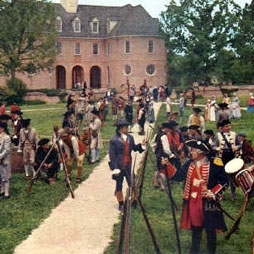
Williamsburg was the thriving capital of Virginia when the dream of American freedom and independence was taking shape and the colony was a rich and powerful land stretching west to the Mississippi River and north to the Great Lakes. From 1699 to 1780, Williamsburg was the political, cultural, and educational center of what was then the largest, most populous, and most influential of the American colonies. It was here that the fundamental concepts of our republic — responsible leadership, a sense of public service, self-government, and individual liberty — were nurtured under the leadership of patriots such as George Washington, Thomas Jefferson, George Mason, and Peyton Randolph.
Near the end of the Revolutionary War and through the influence of Thomas Jefferson, the seat of government of Virginia was moved up the peninsula to the safer and more centrally located city of Richmond. For nearly a century and a half afterward, Williamsburg was a simple, quiet college town, home of the College of William and Mary. CLICK HERE TO BEGIN THE ADVENTURE »
|
 |
Jamestown, Virginia
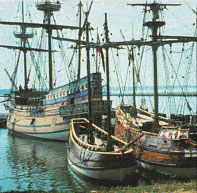
The "Birthplace of America", Jamestown was the first permanent English settlement. In June of 1606, King James I granted a charter to a group of London entrepreneurs to establish an English settlement in the Chesapeake region of North America and to find gold and a water route to the Orient. On May 14, 1607, the explorers landed on Jamestown Island, to establish the Virginia English colony on the banks of the James River 60 miles from the mouth of the Chesapeake Bay. By one account, they landed there because the deep water channel let their ships ride close to shore; close enough, to moor them to the trees.
Immediately after landing, the colonists were under attack from what amounted to the on-again off-again enemy, the Algonquian natives. While disease, famine and continuing attacks of neighboring Algonquians took a huge toll on the population, there were times when the Powhatan Indian trade revived the colony with food for copper and iron implements. The leadership of Captain John Smith kept the colony from dissolving. The "starving time" winter followed Smith's departure in 1609 during which only 60 of the original 214 settlers at Jamestown survived. That June, the survivors decided to bury cannon and armor and abandon the town. It was only the arrival of the new governor, Lord De La Ware, and his supply ships that brought the colonists back to the fort and the colony back on its feet. Although the suffering did not totally end at Jamestown for decades, some years of peace and prosperity followed the wedding of Pocahontas, the favored daughter of the Algonquian chief Powhatan, to John Rolfe. CLICK HERE TO BEGIN THE ADVENTURE »
|
 |
New York City
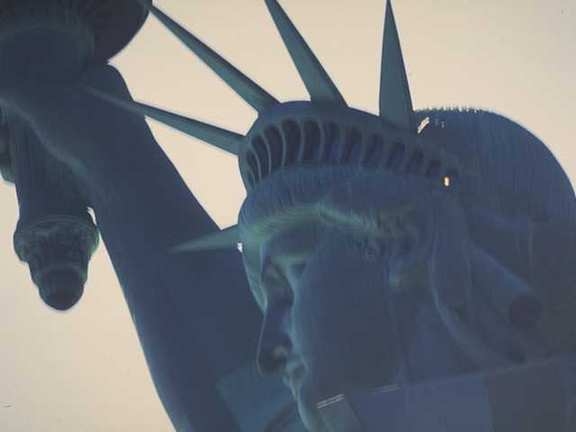
Indian communities were camped around the mouth of the Hudson River in 1524 when the New York Bay was "discovered" by the Florentine Giovanni da Verrazzano. He was exploring the North American coastline for the French king Francis I.
In 1609, Henry Hudson was seeking a water route to the Orient for the Dutch East India Company. He was the first white man to set his foot on "Manahtin", as the place was called by the Algonquin Indians. Hudson explored the harbor region and sailed upriver to the site of Albany.
In 1625, the first permanent settlement was made in lower Manhattan and named New Amsterdam. It was founded as a trading post on the periphery of the Dutch mercantile empire which received little attention from the colonial power. In 1626, the Governor General Peter Minuit purchased Manhattan Island from the Indians for 60 guilders (according to the Blue Guide New York estimated at $24).
In 1664, New Amsterdam was forcibly appended to the rising British Empire and renamed after James, Duke of York, the brother of King Charles II. In 1673, the Dutch recaptured New York and renamed it Nieuwe Oranje (New Orange). The following year, the treaty of Westminster made New York British again. In 1689, King James II facing rebellion abdicated and fled to France. In New York, Jacob Leisler lead an uprising against the British. New York became a vital seaport supplying agricultural products from the Caribbean sugar islands and serving as a British strategic base for military actions against the French. In 1763, the French and Indian War ended with the Treaty of Paris which confirmed English control of North America.
In 1776, the Declaration of Independence marked the beginning of the American revolution after which New York emerged as the linkage point between industrializing Europe and the agricultural hinterland of North America. In 1783, the Treaty of Paris concluded the War of Independence as Britain recognized the independence of the 13 colonies. The British army left New York which, in 1784, became the capital of the state and nation. In 1789, the United States Constitution was ratified and George Washington was sworn in as the nation's first President in Federal Hall on Wall Street. In 1790, the capital moved to Philadelphia, in 1800 to Washington, D.C.
In 1792, the Buttonwood Agreement led to the formation of the New York Stock Exchange. In 1811, a plan to redesign Manhattan was born. Hills, swamps, springs, ponds and forests were eliminated in favor of today's street grid. In 1820, New York became the nation's largest city with a population of 123,706. In 1825, the Erie Canal opened, linking NYC with the Great Lakes; it was to be an essential factor in the city's successful development.
After the Civil War 1861-1865, New York became the principal facilitator of the industrialization of the United States as well as of its imperial westward expansion, the home of America's great banking houses and exchanges, the preeminent portal for immigration, the leading export port, in short the economic, social and cultural capital of the US.
In 1892, an immigration station opened on Ellis Island. In 1898, Greater New York was created by joining the five boroughs under a single municipal government. The population of 3.4 million made New York the world's second largest city behind London (4 million).
After the First World War, New York City rivaled London. In 1929, the stock market crashed and the Great Depression began. In 1941, the United States entered the Second World War. New York, as the major Atlantic port, became important. Brooklyn Navy Yard operated at full capacity. In 1945, the Second World War ended. Since then, New York is the Blue Planet's first city. The same year, an army bomber crashed into the Empire State Building. The United Nations charter was passed and, in 1946, the U.N. selected New York as their permanent headquarters. The same year, another army plane crashed into the Bank of Manhattan Co. building's 58th floor. Today, New York has a booming population of over 8 million people. CLICK HERE TO BEGIN THE ADVENTURE »
|
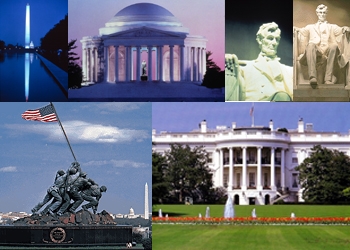 |
Washington, DC
The Piscataway Indians, a branch of the Algonquin, settled in the region in the early 17th century. European settlers began arriving in the decades thereafter, pushing the natives West as the Virginia Colony expanded from the south and the Province of Maryland from the east. The town of Georgetown, generally coterminous with the modern neighborhood of that name, was first settled in 1696, and continuously settled after 1751. The city of Alexandria, Virginia was established in 1749. After the conclusion of the American Revolutionary War in 1783, the new federal government of the United States met in New York City and Philadelphia. Rivalry among the states to be home to the new capital led the 1787 Constitutional Convention to empower Congress in Article I, Section 8 of the new constitution: "To exercise exclusive Legislation in all Cases whatsoever, over such District (not exceeding ten Miles square) as may, by Cession of particular States, and the acceptance of Congress, become the Seat of the Government of the United States...that is, to establish a new federal district governed by Congress which was not part of any state." At a sit-down dinner between Thomas Jefferson and Alexander Hamilton, Jefferson agreed to support Hamilton's banking and federal bond plans in exchange for the choice of a Southern locale for the capital. The actual site of the District of Columbia on the Potomac River was chosen by President Washington. Washington may have chosen the site for its natural scenery, its location near the center of the new country, in the belief that the Potomac had the potential to be a great navigable waterway. The signing of the Residence Bill on July 16, 1790 established a site along the Potomac River as the District of Columbia (seat of government) of the United States. Land for the district was given to the federal government by the states of Virginia and Maryland. The pre-existing towns of Georgetown and Alexandria were absorbed into the new District, with the remainder of the territory subdivided into Washington City and Washington County on the Maryland side of the Potomac (named after George Washington) and Alexandria County on the Virginia side. In 1871, Georgetown, Washington City and Washington County were unified into Washington, D.C. CLICK HERE TO BEGIN THE ADVENTURE »
|
|